AI Was Supposed to Kill the Sales Guru. Instead, It Made Them Installable
The prompt is 5% of the job. Here's the other 95%: five skills, four gurus, and the call archive you already recorded and never opened.
A couple of weeks ago I put up a video about taking a famous sales guru's entire method for winning customers and installing it inside your AI agent, as files. It did numbers, and 8k+ people saved it.
Then the replies came in and they were all basically the same question. Not how do I run these prompts. What do I actually put in each file?
Fair. The prompt is about 5% of the job. Here's the other 95%, in order.
Paid subscribers: → Download the Sales Skills Stack - all five skills, built and ready to drop into Claude (or your AI agent of choice).
Wait, what are we actually building here?
Thirty seconds of setup, because I don't want to lose anyone.
Who this is for. You run a business. You need more customers. You're almost certainly not a salesperson, you never wanted to be one, and you're not about to go read four books about objection handling. That's basically my whole audience and it's who I'm writing this for. If you are in sales, this all still works, you'll just move faster because you already know the words.
What a sales methodology is. It's a named, opinionated system for how to talk to people who might buy from you. Josh Braun has one. Challenger has one. Jeb Blount has one. They wrote the books, they run the trainings, they charge four figures a seat. And that's the business model: the method lives in their head, and you rent access to it.
What an AI skill is. A text file. That's honestly it. You write down how a job should be done, you hand it to your AI agent, and from then on your AI agent does that job that way, every time, without you re-explaining yourself. Anthropic's own line is that skills "turn a general-purpose agent into a specialist."
How you actually get one. Two ways, neither involves code. You paste the file into your AI agent’s settings under Capabilities, or you just ask Claude to write it and save it for you. Then it's there forever, and it wakes up on its own whenever you're doing that job.
A skill is an instruction file you install into your AI agent that teaches it how to do one task, your way. Think of it like hiring an expert, except the expert lives inside your AI and follows your exact process.
Put those two halves together and the whole idea falls out: the methodology is a file now, and files copy.
And the five stages, in English, because I'm going to use these words a lot:
Email outreach. The first cold message to someone who's never heard of you.
Discovery. The first real conversation. You're supposed to be working out whether you can actually help them. Most people use it to pitch instead, which is the entire problem.
Follow-up. The chasing. The bit everyone is bad at.
Closing. The money conversation.
Reactivation. Going back to the people who went quiet six months ago and never said no.
Ok glad we got all the sales jargon out of the way. Let's move on to the actually fun part.
We are going to build 5 separate skills for 5 separate parts of the sales process. The more specific you can create each skill, the better it will perform. Each skill is going to help us optimize each part of that sales process.
How do you build a skill, you ask? Well, just ask your AI agent to and it will. Once that skill is built, you can either trigger it by asking your AI agent to use that skill or you can use a forward slash command that you’ll set when building the skill.
The goal is that you slowly dial in these skills to help you with each part. And whenever you’re stuck, for example, suddenly one of your reps starts underperforming in discovery or maybe people are dropping off after a certain call, then you could use that skill to help improve that process based on the sales thought leaders methodology.
Certain sales thought leaders do best at certain things, so I wanted to base each skill around that specific expert.
TL;DR: the five skills
The whole build in one list. If you save one thing, save this.
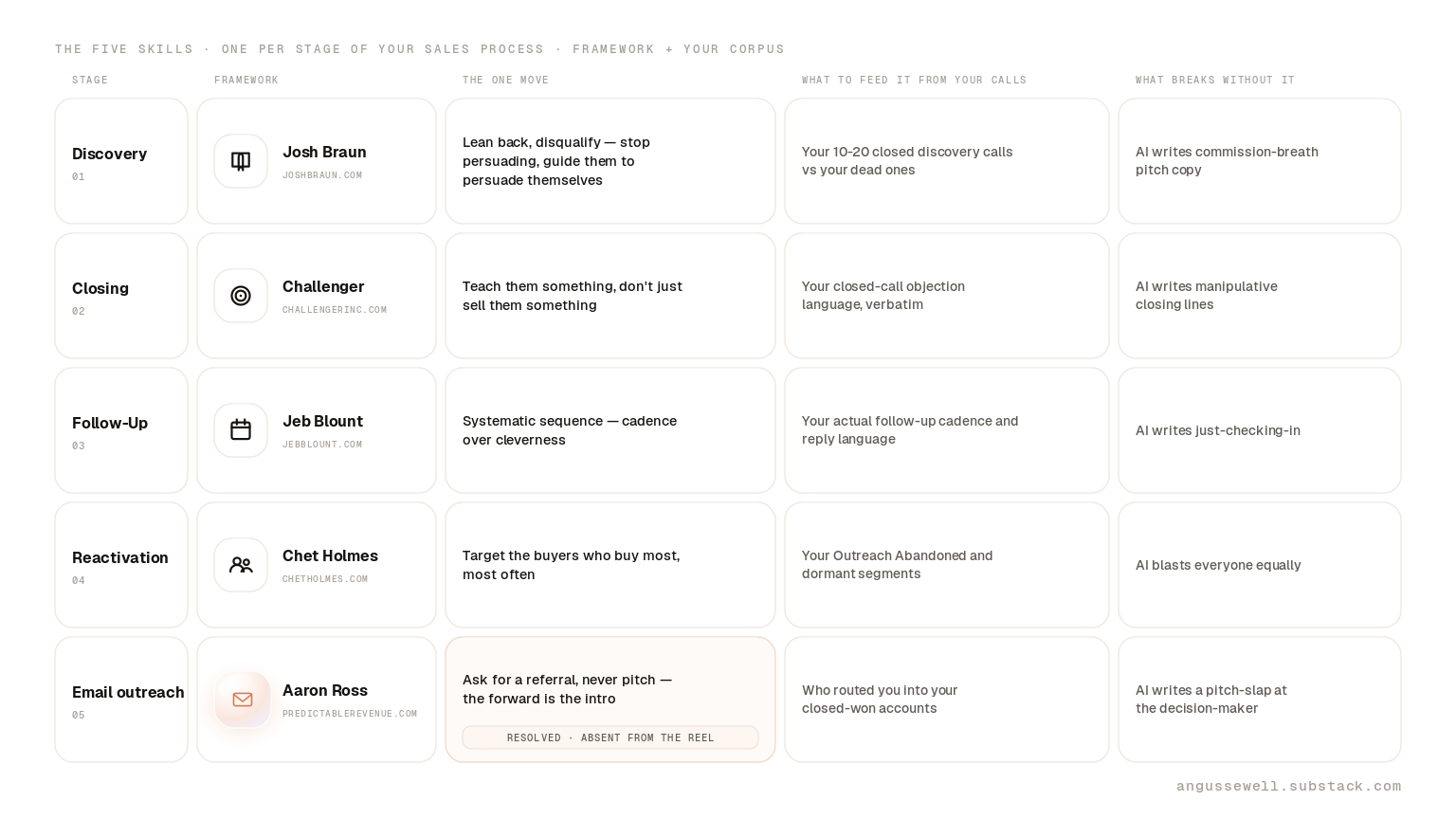
1. Discovery → Josh Braun. The one move: lean back. Stop persuading, start disqualifying. His line is that people "can smell your commission breath whenever you push", and the skill's job is to get that smell out of your questions.
2. Email outreach → Jeb Blount, the 4-Step Email Prospecting Framework. The one move: Hook, Relate, Bridge, Ask, in that order, every time. The most mechanical thing on this list, which is exactly why it installs so well.
3. Follow-up → Jeb Blount again, different framework. The one move: the cadence is the product, not the copy. Vary the channel, never send the same message twice, know when to walk.
4. Closing → Challenger. The one move: teach them something instead of selling them something. Their own framing is a sale that "disrupts customers' current thinking". Weakest card in the set, and I'll show you why.
5. Reactivation → Chet Holmes, Dream 100. The one move: pick the buyers who'd change your business, then be patient and relentless forever. His free 47-point checklist for building the list is worth the click on its own.
Yes, Blount is doing two jobs. More on that in a second, because it's the most interesting thing on this list.
Also, I know there are newer sales methodologies/frameworks such as MEDDPICC, but these are the ones I used to use primarily when I was a head of growth at Accountable (and still use to this day).
But honestly, if you have certain frameworks or methodologies that you like, by all means, please use those when building these skills. Not some guy online (me).
Detailed breakdown: the skills
First, the thing that justifies the whole exercise.
I asked your AI agent, cold, with no framework and no context: "Create an AI skill for my discovery calls." It gave me a clean, well-formatted file with a question bank, a talk-ratio rule, a BANT check, the works. Looked great.
Then I asked it to mark its own homework. It did not hold back:
"Both of these are a Wikipedia summary of sales advice, not a skill. 'Talk 30% of the time,' 'always get a next step,' 'don't send just checking in,' BANT, the Day 0/3/7/14/21 cadence... the median of every sales blog written since 2015. None of it is wrong. All of it is the kind of thing the person asking already knows and has ignored for years, because knowing it was never the bottleneck."
And then the part that actually matters:
"I invented a methodology out of thin air and didn't say so. The discovery structure is my averaged reconstruction of MEDDIC/SPIN/Sandler with the specifics filed off... I should have asked. Instead I asserted a framework with total confidence and zero disclosure that I'd made it up."
And the biggest bummer of them all:
"The failure mode isn't that this is bad. It's that it's good enough to install and never fix... a competence costume."
So the framework isn't decoration on top of the skill. It's the only thing standing between you and a very confident (and usually deeply average) guess wearing your process's name.
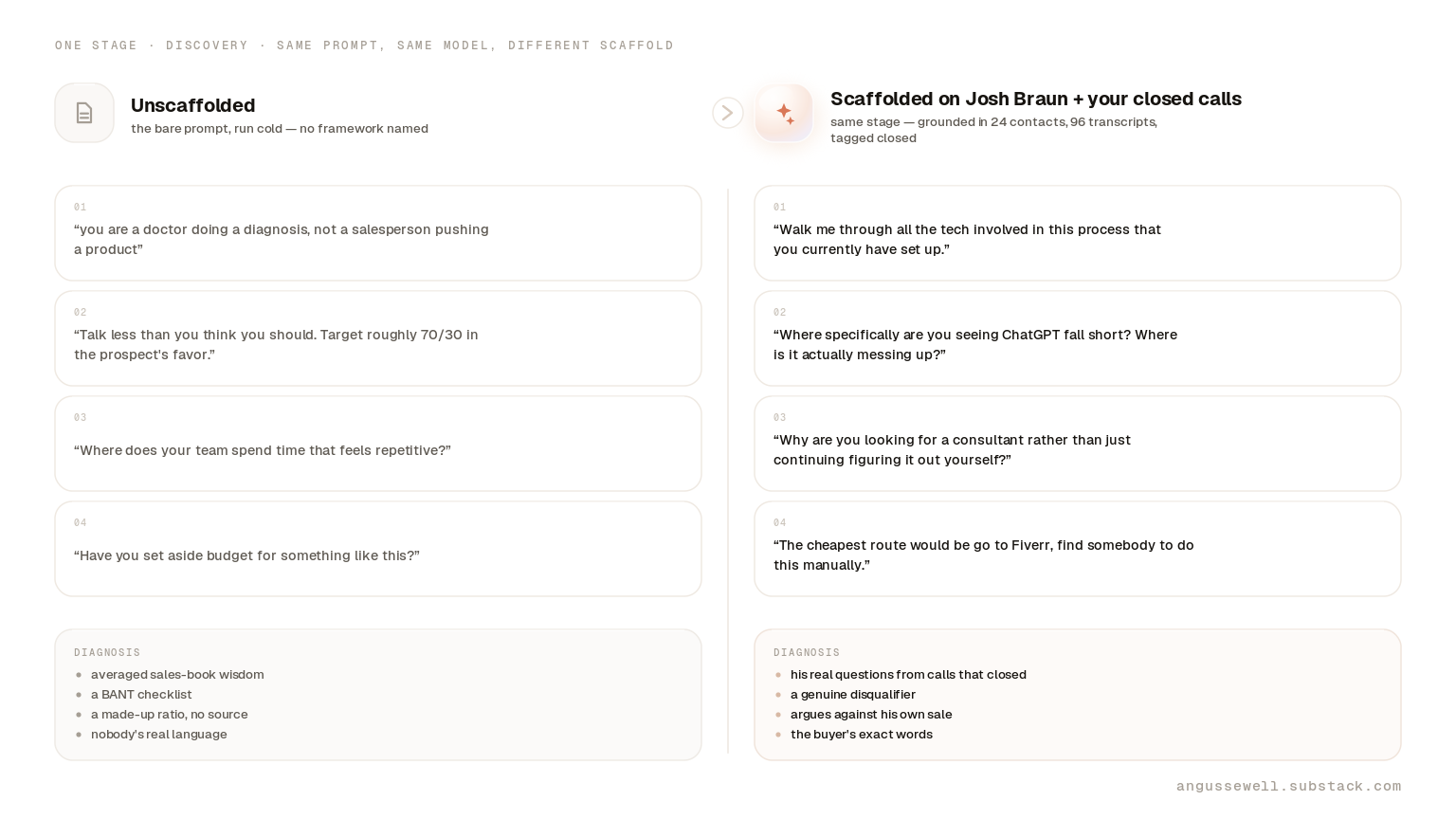
So make your skills specific to that expert and they will perform a lot better. I have based mine on sales methodologies and trainers that I like. So if you don’t know who somebody is when I mention them, assume that they are some (quasi famous) sales guy.
Skill 1: Discovery, on Josh Braun
Why Braun. Discovery is my favorite part of the sale (more on why later), and Braun is the only one of the four whose entire posture is don't push. Most of these hardcore sales bro methodologies bolt a sales pitch with a question mark onto discovery. Braun's doesn't. That’s why I like him.
The one move. Lean back. His words: "Your job is to lean back. To detach from the outcome... Shift from persuading to guiding people to persuade themselves."
Basically this skill will help coach you and help prepare for discovery calls.
Without it. You get the question bank from your AI agent's self-assessment above. "What made you take this call?" works for a $200/mo trial and a $2M enterprise deal, which is precisely why it produces nothing on either.
The prompt:
Create an AI skill called "discovery-call" that coaches me through my
sales discovery calls. Not a document about discovery. A thing I run before
a call to prep, and after a call to find out where I blew it.

Scaffold the posture on Josh Braun: lean back, detach from the outcome,
disqualify rather than persuade, guide the buyer to persuade themselves.
No commission breath. That's the spine the skill holds me to.

FIRST, go and research Braun properly. Do not write this from what you think
you remember about him. Go and read his actual material: joshbraun.com, his
newsletter, his LinkedIn posts, his podcast appearances, his own guides.
Come back with his real vocabulary and his actual named moves, in his words,
with sources I can click.

If you cannot find a primary source for something you are about to put in
this skill, leave it out and tell me. Do not reconstruct a plausible-sounding
Braun out of general sales advice. That is the exact failure this skill
exists to avoid.

Do NOT write a question bank from general sales knowledge either. The skill
has no questions of its own. It gets them from my calls.

I've connected my notetaker to you. Before you write a line of this skill,
go and use it:
- Pull my recent discovery calls
- Ask me which ones closed and which died
- Find the gap: what did I ask on the closed ones that I skipped on the dead
  ones? Where did I lean back, and where did I push?
- Pull my actual phrasing, verbatim, from the calls that closed

Bake that gap into the skill. Then write it so that every time I run it, it
pulls my latest calls through the connector rather than coasting on what you
learned today.

Two modes when I run it. Before a call: prep me on this specific buyer, my
questions, Braun's posture. After a call: read the transcript and tell me
where I pushed, what I should have asked, and what I still don't know about
this deal.

Braun is the structure. My language is the content. If my transcripts
contradict Braun, say so, don't quietly pick one.
What it reads. Ten to twenty of your closed discovery calls, and the same number that died. You point it at them once. After that it goes and gets them itself.
Skill 2: Email outreach, on Blount's 4-Step Framework
Why Blount here. Email outreach is the stage people are most likely to leave unscaffolded, and the one where scaffolding pays off fastest. Blount fills it properly: Fanatical Prospecting has a dedicated email framework (chapter 19, if you have the book), and it's four named elements in a fixed order. That's a skill's dream. The more mechanical the framework, the better it installs.
This skill will help you craft email sequences, it will help you critique your existing email sequences, and especially if you can attach your real email data to it the better. This is where attaching your CRM becomes very helpful.
The one move. Hook, Relate, Bridge, Ask. The Hook earns the read, the Relate earns the trust, the Bridge answers what's in it for me, and the Ask earns the reply. Skip one and the sequence breaks.
Without it. Bracket-swap mad libs. Something like "[One sentence on why it's relevant to them specifically]". The AI leaves the entire hard part as an exercise for you, then takes credit for the email.
The prompt:
Create an AI skill called "email-outreach" that drafts my cold
prospecting emails with me. I run it when I need to reach someone, and it
writes in my voice and tells me why each line is there.

Scaffold it on Jeb Blount's 4-Step Email Prospecting Framework from
Fanatical Prospecting: Hook, Relate, Bridge, Ask. All four, in that order.
The subject line is about them, not me.

FIRST, go and research the framework properly. Do not reconstruct it from
memory or from the dozen blog posts that paraphrase it. Find Blount's own
treatment of it: the book itself, jebblount.com, Sales Gravy, his talks and
interviews. I want to know what each of the four elements actually means to
HIM, what he says a bad one looks like, and the order rule and why it exists.
Quote him. Give me sources.

If the sources disagree with each other, or you can only find secondhand
summaries of a step, say that plainly in the skill rather than papering over
it with confident-sounding filler.

Then, for the content, do NOT use generic B2B email advice, and do not leave
me bracket-swap mad libs to finish myself.

Go and read my actual material through the connectors:
- My sent folder, filtered to threads that got a real reply
- My call transcripts, because how I describe the problem out loud is better
  than how I write it
Pull out the hooks that actually got replies from MY prospects, the way I
actually describe the problem, and which specific outcome I bridged to which
specific pain, for which type of buyer.

Write the skill so that when I run it on a prospect, it pulls their context
live, drafts the email in my voice on Blount's structure, and labels which
of the four elements each line is doing so I can argue with it.

If you don't have enough of my material for some part of this and you're
about to fall back on generic advice, put that in the skill. Do not fill the
gap silently.
What it reads. Your sent folder, filtered to threads that got a reply. Plus the transcripts, because how you describe the problem out loud is usually better than how you write it.
Skill 3: Follow-up, on Blount's cadence doctrine
Why Blount twice. Because I looked for a separate follow-up canon and there isn't one worth the name. Follow-up is very much Blount's territory: the 30-Day Rule, the Law of Replacement, the whole fanatical-persistence doctrine. Pretending otherwise means bolting on a second guru for the sake of a tidier table.
So: four gurus, five skills. The map obviously isn't clean, and anyone who tells you their methodology maps perfectly onto their pipeline is selling you a course.
The one move. The cadence is the important part, not the copy. Vary the channel, never send the same message twice, and know when to walk.
Shis skill will help you figure out how to set up follow-up cadences so nobody gets off the hook that easy.
Without it. The Day 0/3/7/14/21 cadence that every sales blog since 2015 has published, presented to you as though it were derived from your business.
The prompt:
What it reads. Whole threads, not single emails. The gaps between the touches are the data.
Skill 4: Closing, on Challenger
Why Challenger. It's the closing framework with an actual point of view: don't serve the customer, teach them. Their homepage claim is that "the best companies grow, and grow fast, by challenging customers, not by serving them."
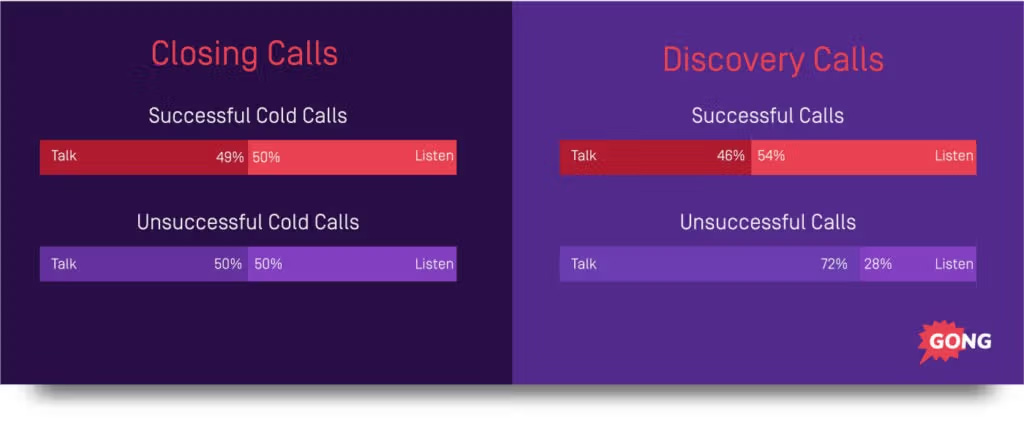
Here's the honest problem with this one, and it's the weakest card in the set. Gong analyzed more than a million B2B sales calls, 42,945 of which were closing calls. Their finding: winning and losing closing calls are nearly indistinguishable. Same question counts. Same demo interactivity. The close is where the least signal lives.
So the flashiest framework on this list is scaffolded onto the stage that matters least. I'd still build it, because a skill that keeps you consistent on a low-signal stage is better than improvising. But if you only build three, this isn't one of them.
(Worth saying plainly: that Gong research is published by a company selling call-recording software, the methodology isn't public, and the data is old. Treat it as a strong hint, not physics.)
The one move. Teach them something they didn't know about their own business.
This skill will help coach you on your closing calls. and help you prep for future closing calls.
The prompt:
What it reads. Closed-won and closed-lost, and brace yourself, this is the pair most likely to come back looking identical.
Skill 5: Reactivation, on Chet Holmes' Dream 100
Why Holmes. Dream 100 is the only one of the four built for the long game: pick the buyers who'd change your business, and stay in front of them for years. That's what reactivation is.
The one move. Pick the 100 that matter. Then be relentless and patient at the same time.
This skill will help you reactivate people that have gone dark. Leads that have probably ghosted you.
Without it. "Hey, just circling back!" to your entire dead list.
The prompt:
What it reads. Every stalled deal, plus whatever your CRM knows about why.
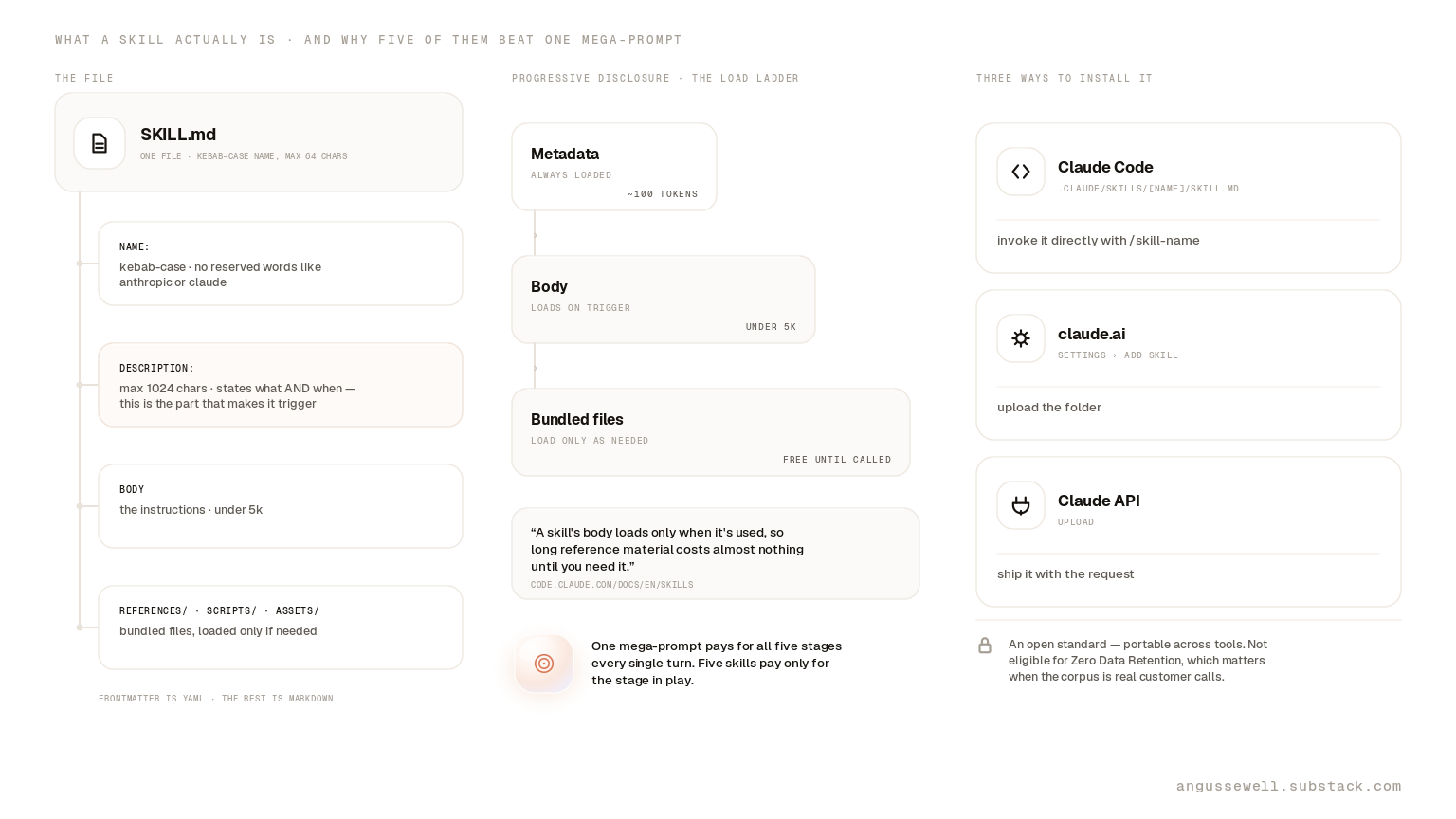
One thing worth knowing before you write any of these: a skill's body only loads when your AI agent actually uses it. Anthropic's own docs put it well: "a skill's body loads only when it's used, so long reference material costs almost nothing until you need it." That's the real reason five skills beat one giant prompt. Five separate skills only wake up the one you're actually in.
Detailed breakdown: transcript sources
Every prompt above sends the skill off to read your calls itself, once when you build it and again every time you run it. So it needs a way in, and this is where most people hit a wall they didn't see coming. Most of these plug into your AI agent with a connector, an adapter that lets your AI agent reach into one of your apps and read it. (You'll see these called MCPs. Ignore the acronym.) Verdicts:
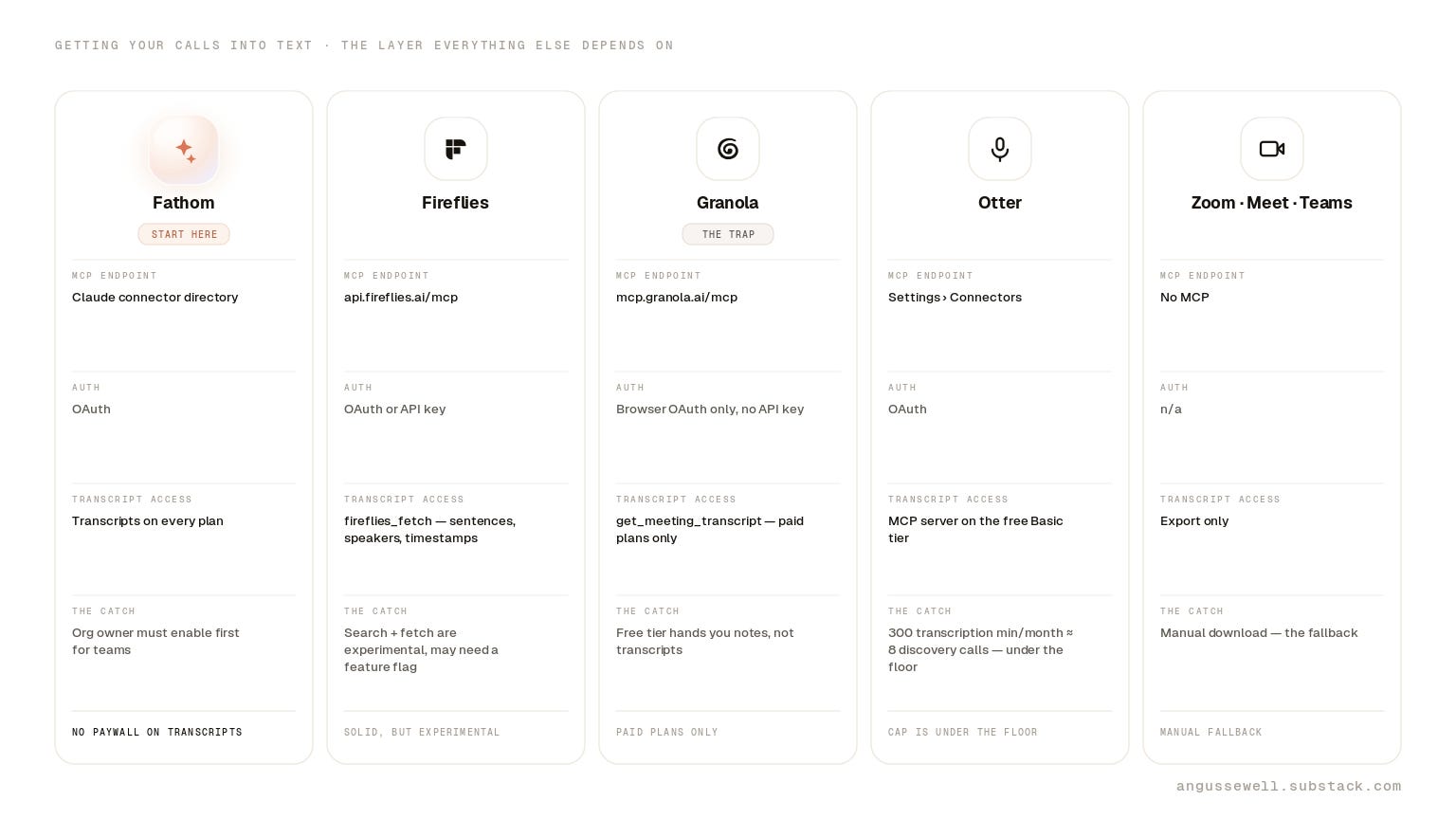
Fathom: the pick. Official Claude, transcripts included, and Fathom advertises it "on every plan." That's their marketing copy rather than a pricing table, so verify against your own account, but it's the only one making that claim at all. Connect it from the Fathom connector inside your AI agent.
Granola: the trap. Everyone's favorite notetaker, and the wrong default pick here. The connector works fine, but pulling the actual transcript is paid plans only. Free tier gets you 30 days of notes, not transcripts. Notes are a summary of the call. This entire build needs the actual words. Most popular tool, most likely to waste your afternoon.
Fireflies: solid runner-up. Full conversation with speakers and timestamps, and the most flexible to connect of the lot. One gotcha, straight from their docs: the search and fetch tools are "experimental tools that may not be available to all users."
Otter: fine, but count your minutes. The connector is on the free Basic tier, so access isn't the gate. 300 transcription minutes a month is. That's about five hours of calls. Fine for a backfill, tight for a live pipeline.
Native Zoom / Meet / Teams: the fallback. No connector. Export the transcripts and hand your AI agent the files. Ugly, works, free.
One expectation-setter, in Fathom's own words: "MCP doesn't provide access to new categories of data", it "mainly makes it easier for Claude/ChatGPT to retrieve the meeting context you need." It can only see meetings you already have access to, so it's a retrieval shortcut and nothing more.
And one myth to kill: you do not need a paid Claude plan for this. Custom connectors run on Free, Pro, Max, Team and Enterprise, per Anthropic's own docs. The paid gate is on the notetaker, not on Claude.
Detailed breakdown: the wiring
Connect in this order. Each one earns the next.
Transcripts first. Nothing else matters until the skills have material. I assume you have some sort of AI meeting recording software like Fathom or Granola. Your AI agent should have a built-in connector.
Then Gmail and Google Calendar. This is where it stops being a writing tool. Once your AI agent can see your calendar and your inbox, "who do I follow up with today, and use the Chet Holmes skill on the top three" is a sentence that actually does something.
Then your CRM. Super helpful if you want help with outreach. Your transcripts already know more about your deals than your CRM does. Add it when you want the pipeline stages, not before.
Then, if you want to get crafty, the custom stuff. This is only relevant if you have tools that you want to connect that are outside of what already exists in your AI agent's built-in connector list.
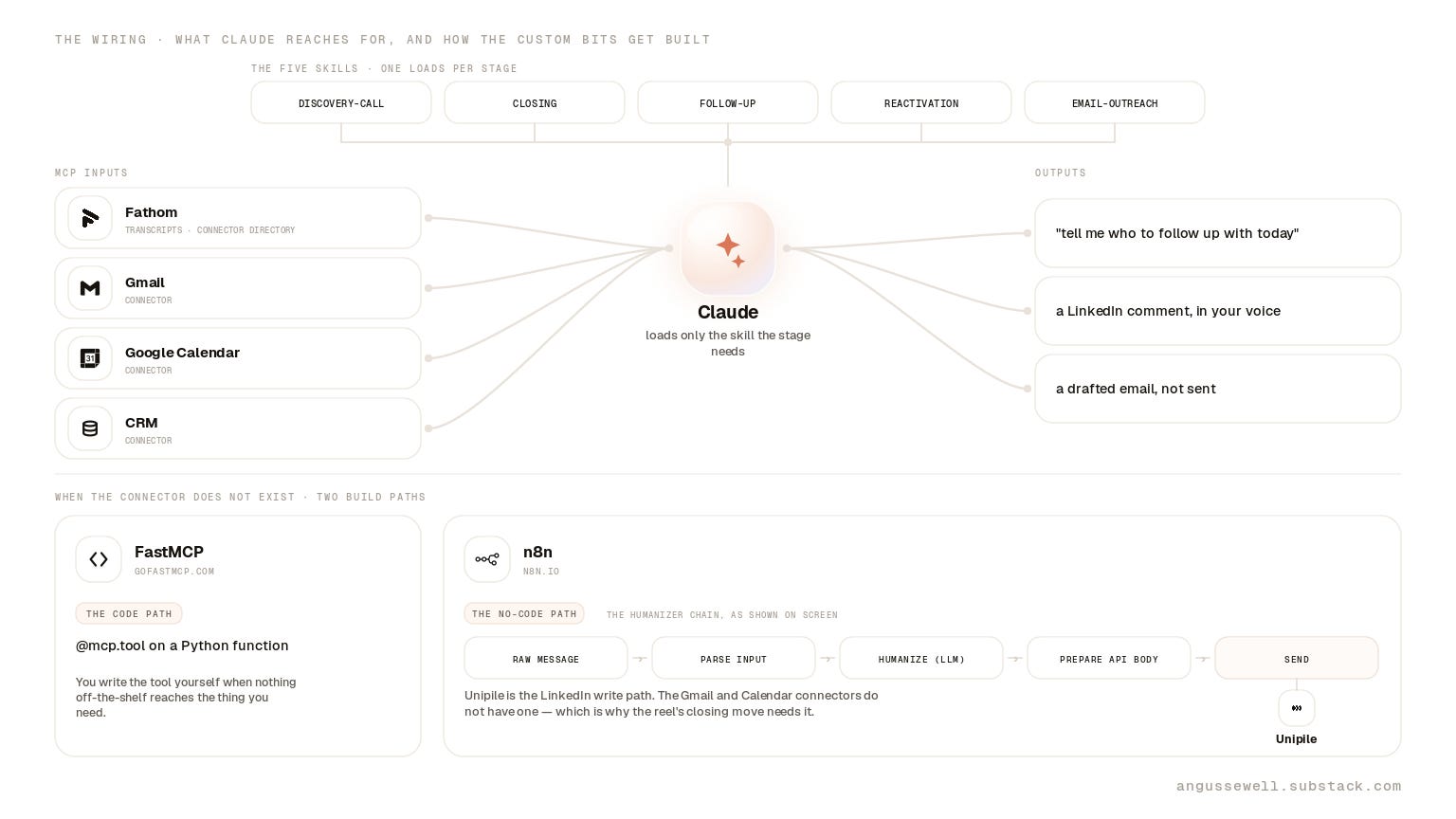
Two build paths. FastMCP is the Python route. You write a normal function, add one line above it, and it becomes a tool your AI agent can call. n8n is the no-code route, and it's the one I'd actually reach for: raw message → parse → an LLM rewrites it so it doesn't sound like a robot → send via Unipile or Gmail. Unipile is what makes the LinkedIn move possible: one API across LinkedIn, Gmail and WhatsApp, so "comment on their post" becomes a thing your AI can do rather than a thing you have to go do.
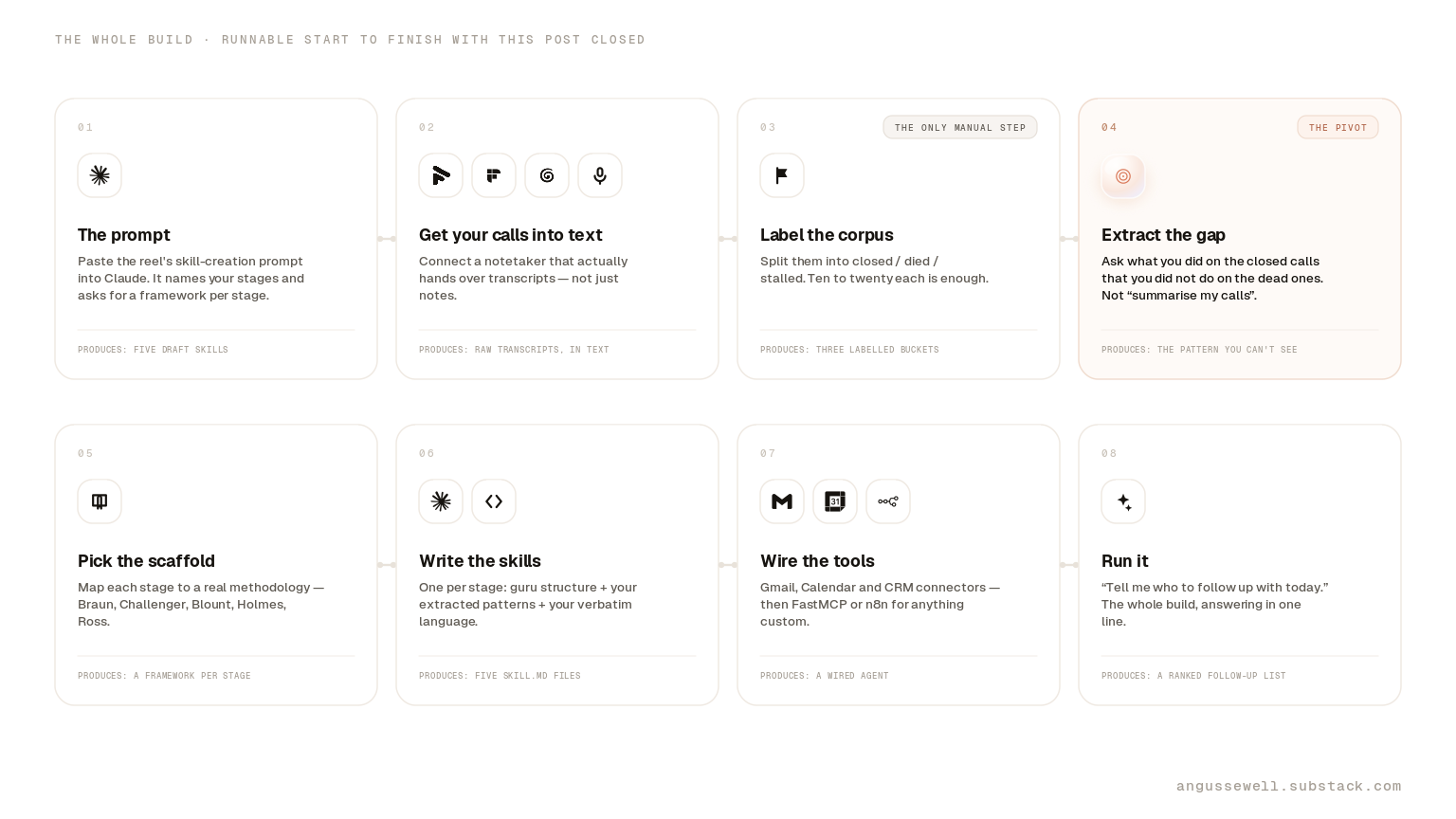
Detailed breakdown: the upgrade that makes it yours
Here's the bit almost nobody does, and it's kinda whole difference.
The lazy version of every prompt above stops at "here's how my process works, paste your details here." Think about what that actually is. It's you, from memory, typing the sanitized version of what you think you do. Not what you do.
Meanwhile the calls are all recorded. Sitting there. Your meetings are your methodology, and you just never read them back.
I checked mine while writing this. 361 recorded call transcripts sitting in my database, 168 different people, April through July, averaging 32,539 characters each. Every objection I've ever fumbled is in there somewhere, written down, waiting.
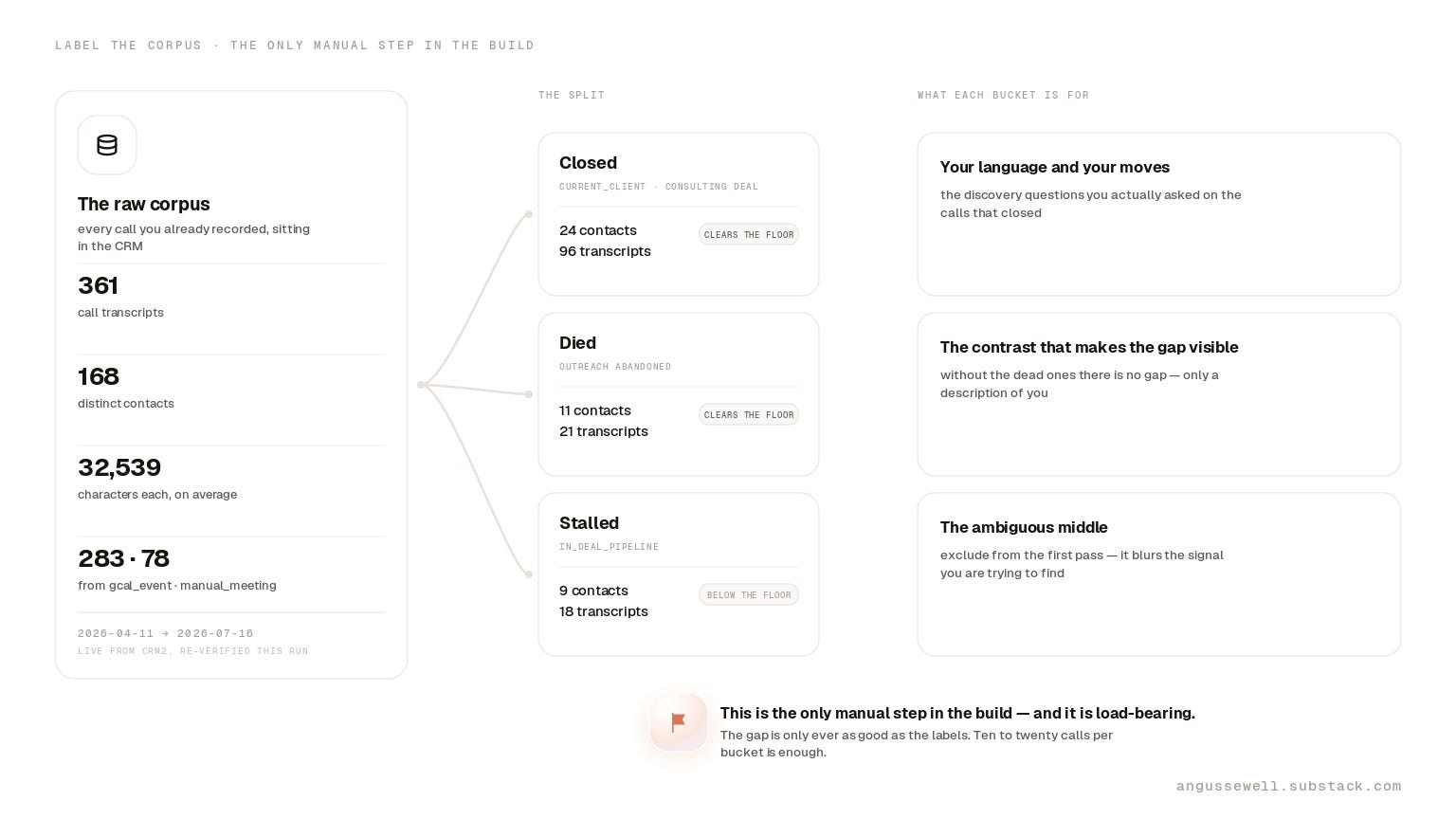
Do not ask it to summarize your calls. Summaries are where insight goes to die. Split them into three buckets, closed, died and stalled, then ask the only question that matters:
What did I do on the calls that closed that I didn't do on the ones that died?
Ten to twenty per bucket is plenty. I would label the calls some way shape or form. this can be a tag in Fathom or whatever your meeting transcript software is. It can cross reference the deals in your CRM to figure out which is closed and which one’s not. It just needs that data somewhere. Labeling is probably the easiest.
Now, where to point it. Not everywhere. Discovery. Gong's million-call sample found closing calls barely differentiate, but they analyzed over 519,000 discovery calls and those differ starkly between winners and losers.
An independent study backs it up. Nimitai looked at 350 recorded B2B calls and found the correlation between talk ratio and outcome was strongest on discovery (r = -0.46) and weakest on closing (r = -0.18). In plain terms, how much you talk really matters on a discovery call and barely registers on a closing call. Different sample, different people, same shape: the signal is upstream. They also found that counting open questions predicts outcome better than talk ratio does.
Credit to Nimitai for saying the quiet part about the research everyone quotes, Gong's included:
"That number has been quoted widely, but the underlying sample and methodology are not public, the data is several years old, and the population skews toward enterprise SaaS."
Last thing, and it's the honest limit. A transcript records what someone said, not what was true. User Intuition interviewed 10,247 buyers after the decision and found price gets cited in 62.3% of lost deals but is the actual primary driver in only 18.1%. A 44-point gap between the reason you were given and the reason you lost.
So no, twenty calls isn't science. You're not running a study. You're biasing the skill toward your language instead of a stranger's, and the guru framework is there to supply the rigor that twenty calls can't. That's the whole trade.
So, go pirate someone
Recap of what actually matters here: the frameworks are free and public, the prompts take a minute, and neither is the moat. Anyone can install Josh Braun. The gap between a generic Braun skill and yours is the twenty-odd calls you already recorded and never listened to again.
What I'd build first if I were you: discovery, not closing. That's where the data says the difference lives, and it's the one you'll feel within a week.
Skills do take dialing in, so start using them and see how they do and give the skills feedback once they’re done to improve. And over time, they will.
But over time, what happens is not only do the skills get better, but you get better. You start to learn from the AI and you yourself become a more capable salesman. And at the end of the day, that’s really what matters. AI doing the work can only take you so far, but you becoming that capable high closer that naturally creates business will be really what moves the needle here. Not just you creating fancy skills. But the fancy skills will be what gets you there.
Or skip the copy-paste. I packaged all five of these, discovery, email outreach, follow-up, closing and reactivation, into one skill pack you can drop straight into your AI agent: → The Sales Skills Stack. It's in the Member Vault, so you'll need to be a paying member to grab it.
Sales gurus spent a decade making their methodology into a thing you had to buy from them. It's a text file now. Go install one, then point it at your own calls so nobody can install yours.